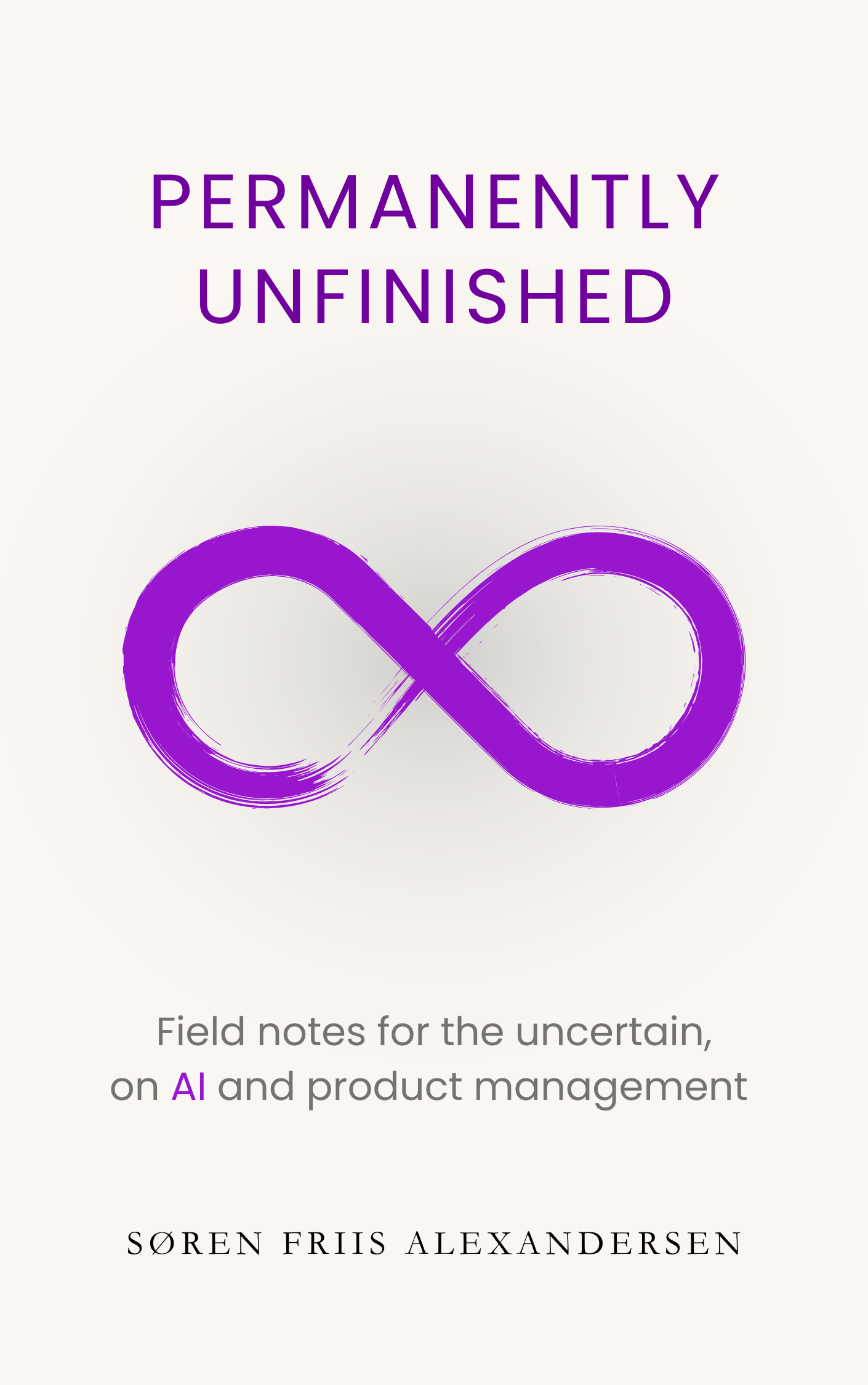
The book
Written from inside the transition, not after it
Permanently Unfinished is a field notebook for product managers learning to work inside
a squeeze that AI has made permanent: relentless external noise insisting AI changes everything; competitive
paranoia flowing from the boardrooms of companies down through the ranks; and the private uncertainty of not knowing what
you're capable of with these tools, or what's expected of you to stay relevant.
This is not a guide to the tools and AI models. It is a reflection of the author's personal lived experience
as a product manager in a large software company, on boundaries between product, engineering, and design dissolving, and roles inevitably
reforming, and finding your way as a consumer of AI and a producer of AI.
It's about finding signal in
the noise, reading the silence, and navigating uncertainty when shipping AI features as continuous experiments,
and embracing the discomfort of burying the Minimum Viable Product concept.
The book will ask as many questions as it tries to answer, and mostly it empowers the reader with a sense of agency
and methods for making peace with ever growing uncertainty in an AI-hyped world, where snake oil exists side by side with real tangible value,
but where value requires constant experimentation and the master skill is knowing what to build,
and where AI pushes us to stay relevant in new, unexplored ways.
Permanently Unfinished is a human story seen through the lens of product management, told from inside a transition still underway.
“Many people around you are likely having the same private conversation with themselves that you are; wondering if they're keeping up and staying relevant,
wondering if anyone else feels this confused too. AI is a fantastic tool, but I can go from full confidence to self-doubt on the same day because of the uncertainty AI brings with it.
Uncertainty won't go away any time soon, so the best we can do is to embrace it as a new working condition, give ourselves permission to explore, set our imagination free, and notice the costs, one experiment at a time.”
— Søren Friis Alexandersen